
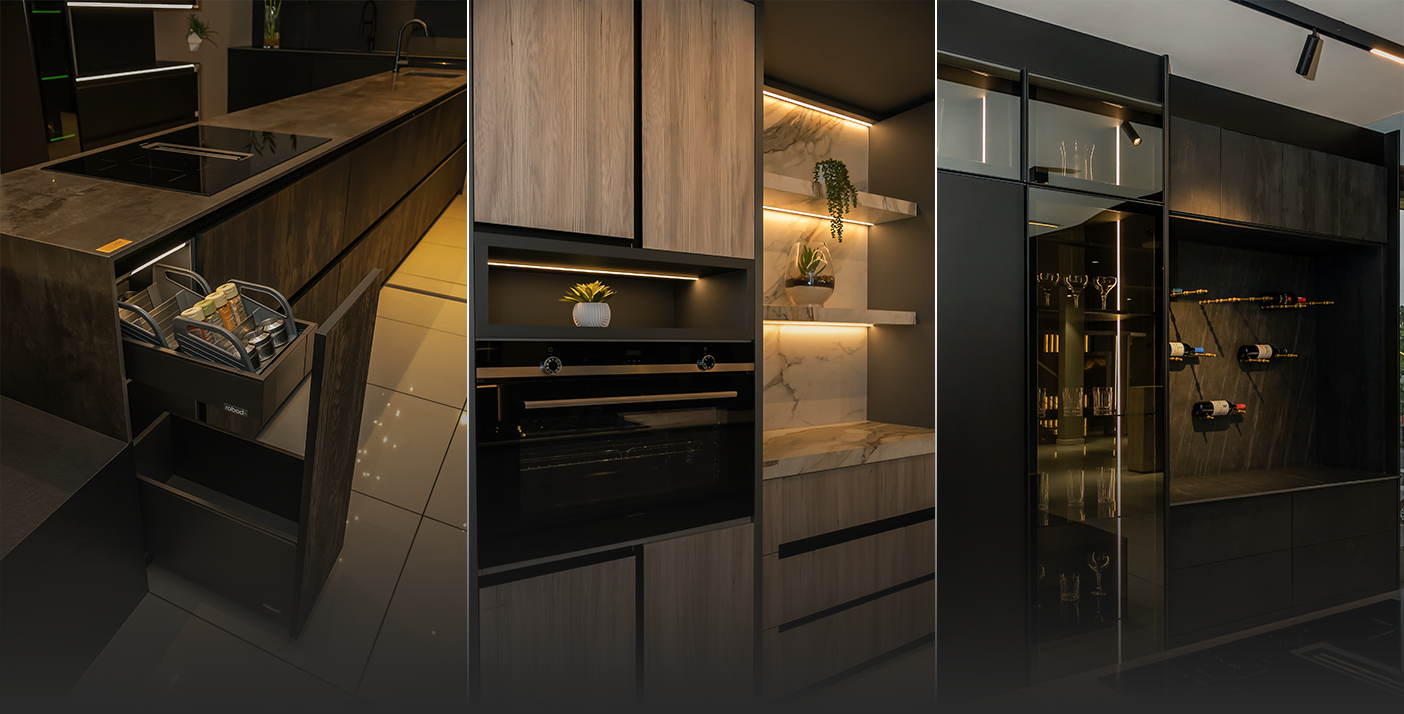
There is a point in every luxury kitchen where price stops being the true measure of quality.
It is not the moment a premium appliance is selected. It is not the choice of an imported surface, rich veneer or statement island. These features can contribute to a beautiful kitchen, but they do not automatically make it bespoke.
The real difference is often found in something much smaller: a millimetre.
It appears in the alignment between cabinet doors, the consistency of a shadow gap and the way a drawer closes. It can be seen where a countertop meets the cabinetry beneath it or where an integrated appliance sits within the surrounding design.
To a discerning homeowner, architect or interior designer, these details reveal whether a kitchen has simply been made expensive or whether it has been designed, manufactured and installed with precision.
This is the millimetre test.
Expensive Is Not the Same as Bespoke
A kitchen can be expensive without being truly bespoke.
It may include premium finishes, advanced appliances, architectural lighting and impressive surfaces while still relying on standard dimensions, awkward filler panels or poorly planned storage.
A bespoke kitchen is different. It is designed around a specific home, lifestyle and way of living.
It considers how the homeowner cooks, entertains, stores and moves through the space. It asks whether the island is primarily a preparation area, dining surface or social gathering point. It examines which appliances are used most often, which items should be concealed and how the kitchen should connect with adjoining rooms.
An expensive kitchen can be selected from a range of options.
A bespoke kitchen must be resolved around the client and the property.
Homeowners can explore examples of bespoke modern kitchens to see how different layouts, materials and cabinetry solutions can respond to individual spaces.
Precision Begins at the Design Stage
The millimetre test begins long before the cabinetry reaches the home.
It starts during the design process, when proportions, clearances, storage requirements, appliance positions and movement patterns are considered together.
Every decision affects another.
The width of a drawer affects what can be stored inside it. The height of a cabinet affects accessibility. The position of a refrigerator or oven affects movement through the room. The thickness of a surface influences the visual line of an island or cabinet run.
A bespoke kitchen should therefore be designed as a complete interior system, not as a collection of separate products.
Precision at this stage can make the kitchen:
-
Easier to move through
-
More comfortable to use
-
Better organised
-
More balanced in proportion
-
Better suited to the homeowner’s routine
-
More closely integrated with the architecture
A kitchen that feels effortless is rarely the result of chance. It is usually the outcome of disciplined planning.
The Details That Reveal Bespoke Quality
Many of the strongest signs of quality are not dramatic.
They are the details homeowners notice gradually: the quiet movement of a drawer, the clean meeting point between finishes and the absence of awkward gaps.
Cabinet Alignment and Shadow Gaps
Cabinet doors and drawer fronts should form clear, consistent lines.
Uneven spacing, doors sitting at different heights or drawers failing to close flush can weaken an otherwise impressive kitchen. This is especially noticeable in minimalist interiors, where there are fewer decorative elements to distract the eye.
Shadow gaps and joins should also look intentional. Where one panel meets another, the spacing should remain controlled. Where cabinetry meets a wall, ceiling, floor or countertop, the transition should feel carefully resolved.
Real homes often contain uneven walls and floors. Bespoke design accounts for those conditions rather than assuming every surface is perfectly straight.
Integrated Appliances and Storage
Integrated appliances should feel like part of the cabinetry rather than additions placed into it afterwards.
Their dimensions, ventilation requirements, service connections and door clearances must be considered before manufacturing begins. Poor coordination can create visual imbalance, obstructed openings or unnecessary gaps.
Storage deserves the same attention.
A bespoke kitchen should be shaped around what the client actually owns and uses. Frequently used cookware should be easy to reach. Pantry items should be organised logically. Small appliances, waste systems and serving pieces should each have an appropriate place.
The objective is not simply to create more storage. It is to create better storage.
Readers can view completed kitchen and interior projects for examples of cabinetry integrated into different residential environments.
Why Manufacturing Matters
A strong design can only succeed when the manufacturing process can deliver it accurately.
Cabinet components must be measured, cut, edged, drilled, assembled and finished consistently. Hardware must be positioned correctly, materials must be handled appropriately and each component must be prepared for the final installation.
A small manufacturing error can create a much larger visual problem.
An inaccurate panel may affect the alignment of several doors. An incorrect appliance dimension can disrupt an entire cabinet run. Poor edging or drilling can compromise both appearance and performance.
Manufacturing is therefore not simply a production stage. It is the bridge between design intent and the completed kitchen.
Learn more about Robod’s precision cabinetry manufacturing process and how technical accuracy supports the final result.
Installation Is the Final Test
Installation is where every earlier decision is tested in the reality of the home.
It is also where shortcuts become visible.
Cabinetry must sit correctly despite uneven site conditions. Doors and drawers must be adjusted. Panels must meet surrounding surfaces cleanly. Integrated appliances must open and operate without obstruction.
A professional installation team does more than position cabinets. It interprets the design within the actual property and completes the final adjustments required to protect the intended result.
Luxury at this stage can be recognised in the absence of:
-
Uneven cabinet lines
-
Inconsistent gaps
-
Rough transitions
-
Poorly fitted panels
-
Obstructed doors
-
Uncomfortable proportions
-
Hardware that does not operate smoothly
Homeowners who want to examine cabinetry, finishes and functional details in person can visit the Robod Fourways showroom.
Custom and Bespoke Are Not the Same
The words “custom” and “bespoke” are often used interchangeably, but they do not always describe the same service.
Customisation may involve selecting from predetermined finishes, handles, colours or cabinet configurations. Some dimensions may be adjusted, but the solution can still be based on a standard system.
Bespoke design starts with the project itself.
It considers the relationship between the client’s lifestyle, the architecture, the room dimensions, the required functions, the materials, the manufacturing method and the installation conditions.
The kitchen is not built around what is easiest to supply. It is developed around what the property and client require.
This does not mean the final design must be visually complex. Some of the most refined bespoke kitchens are calm and minimal. However, simplicity demands even greater precision because every line, join and proportion becomes more visible.
Premium Materials Are Not Enough
Premium materials can elevate a kitchen, but they cannot correct weak design or poor execution.
An expensive surface loses its impact when it is badly fitted. High-quality hardware cannot perform correctly when it has been installed inaccurately. A beautiful veneer cannot hide inconsistent cabinetry lines.
The value of a bespoke kitchen depends on four connected elements:
-
Design: The layout and details must respond to the home and its users.
-
Materials: Every finish and component must suit its intended purpose.
-
Manufacturing: The design must be produced accurately and consistently.
-
Installation: Every element must be fitted and adjusted with care.
When one of these areas is weak, the whole result can be affected.
Read more about how Robod delivers bespoke transformations from initial planning to final installation.
What the Millimetre Test Means for Clients
For homeowners, the millimetre test is about long-term satisfaction.
A kitchen is used during rushed mornings, quiet evenings, family routines and social occasions. Small frustrations become significant when they are experienced every day.
A poorly positioned appliance may interrupt movement. Insufficient storage may create clutter. Misaligned doors may become increasingly noticeable. An oversized island may reduce comfortable circulation.
The real test of a luxury kitchen is not only how it looks on installation day. It is how naturally it supports daily life months and years later.
For architects and interior designers, the millimetre test is also about trust.
A cabinetry partner should be able to interpret design intent, resolve technical details, coordinate appliance requirements, manufacture accurately and respond appropriately to site conditions.
Professionals can explore Robod’s cabinetry services for architects for information about design collaboration and project support.
The Robod Approach
At Robod, bespoke kitchen design is approached as a coordinated process rather than a collection of separate product choices.
Design, manufacturing, craftsmanship and installation must work together to create cabinetry that feels refined, functional and appropriate for the property.
Robod’s broader offering includes luxury kitchens, built-in cupboards, bars, television units, vanities and home-study cabinetry.
Explore luxury kitchens and bespoke interior cabinetry by Robod to learn more about the available solutions.
A bespoke kitchen should feel effortless when complete, but that result is never accidental. Behind clean lines and seamless finishes lies a disciplined process of measurement, technical planning, material selection, manufacturing and installation.
That is what separates a kitchen that is simply expensive from one that is truly bespoke.
Frequently Asked Questions
What makes a kitchen truly bespoke?
A kitchen is truly bespoke when its dimensions, layout, storage, materials and details are designed around a specific property and client rather than being based primarily on standard cabinet configurations.
Is an expensive kitchen automatically bespoke?
No. A kitchen may contain premium surfaces and appliances while still using standard dimensions or poorly resolved details. Bespoke quality depends on design, personalisation, manufacturing and installation.
What is the difference between custom and bespoke kitchens?
A custom kitchen may allow certain options or dimensions to be changed within an existing system. A bespoke kitchen is developed more comprehensively around the room, architecture, lifestyle and functional requirements.
How can you identify high-quality kitchen cabinetry?
Look at door and drawer alignment, consistent gaps, clean joins, stable shelving, smooth hardware movement and the way the cabinetry meets surrounding walls, floors, ceilings and surfaces.
When should appliances be selected?
Major appliances should be selected before the cabinetry design is finalised so that their exact dimensions, ventilation, connections and opening clearances can be accommodated.
Are premium materials worth using?
Premium materials can improve appearance and performance when they are appropriate for the application. However, they must be supported by strong design, accurate manufacturing and careful installation.
Every Millimetre Should Have a Purpose
When evaluating a luxury kitchen, it is easy to focus on the obvious features: the surfaces, appliances, lighting and initial impression.
The more useful question is whether the detail holds up.
Study the alignment. Open the drawers. Examine the joins. Consider the proportions. Ask how the storage was planned, how the cabinetry was manufactured and how the installation will be managed.
In a truly bespoke kitchen, quality is not established through broad claims about luxury.
It is revealed in the millimetres.
Begin Your Bespoke Kitchen Journey
Your kitchen should do more than look impressive. It should fit your home, support your lifestyle and perform beautifully in daily use.